Jumat, 08 Mei 2015


Rabu, 06 Mei 2015
Blended Learning
Blended Learning
 | ||
| https://www.middleburyinteractive.com/images/uploads/chart-blended.jpg
The blended classroom
is designed to meet the individual needs of student by allowing teachers to
personalize instruction. This strategy
can be used for any subject and any grade level. Blended learning combines face-to-face and
online instruction. It allows students to work with teachers in school and have
online resources at home. It is similar to the flipped classroom, but with more
emphasis on in-class work with the teacher over video/home content. Project
Based Learning is a type of blended classroom. Students work on projects at
home, and in class. In class, they can ask the teacher for help, and continue
on the project at home, with online materials for help. By having online
materials available, students have access to support when out of the classroom.
Students access some material at home and complete some work at home, while
leaving more time during class to get into deeper context with the teachers.
There are some advantages
of Blended Learning, that are:
1.
provides for individualized support for
the students
2.
students can access material at anytime,
anywhere, to review the material
3.
provides richer, more interactive learning
experiences
4.
provides more time for collaboration with
the students and teachers
5.
parents have access to what students are
doing - better communication and support
6.
studies show it increases student and
teacher productivity, improves teaching and learning, and provides more and
better data, and helps customize learning.
7.
more and more colleges and even workplaces
are using this model
8.
gives students more time to learn -
extends the learning beyond the end of the school day
There are also some disadvantages of Blended Learning, that are :
1.
Teachers will need time to create and/or
select content.
2.
Teachers will need training on using this
method of instruction to make it effective
3.
students will need to be shown how to
access, use the technology and what is expected of them
4.
Students need to be able to do work
outside of school hours
·
do they have access to technology at home?
·
do they have access to internet at home?
·
do they have other things that take up
their time (job, etc.)
·
students need to be self-directed to work
at home
Based on the
explanation above, I think Blended Learning is useful for the teachers and the
students although there are some disadvantages in conducting Blended Learning.
However, to decrease the disadvantages from Blended laerning, the teachers have to be trained on using this method of instruction to make it
effective and students need to be
shown how to access, use the technology and what is expected of them.
As blended learning
becomes more common, schools and professors will likely understand and implement
it better. Yet even now, blended education shows promise, making this an exciting
time to be a student.
references :
1. https://www.middleburyinteractive.com/curriculum-courses/blended-learning
2. http://olecommunity.com/blended-learning-what-is-it-and-why-is-it-trending-in-k-12-education/ 3. http://moodle.unitec.ac.nz/mod/page/view.php?id=214273 4. http://elearninginfographics.com/6-blended-learning-techniques-infographic/ 5. https://www.youtube.com/watch?v=L75oPzauAlw 6. http://www.christenseninstitute.org/blended-learning-definitions-and-models/ 7. http://kevincorbett.com/2013/07/4-blended-learning-models/ |
Minggu, 19 April 2015
E-Learning
 | ||
| Source : http://e-learning.jaroji.com/pluginfile.php/249/block_html/content/E-learning.png |

What is e-learning?
E-learning (also called electronic learning) is any type of learning that
takes place through or with a computer. E-learning is primarily facilitated
through the Internet but can also be accomplished with CD-ROMs and DVDs,
streaming audio or video and other media. The purpose of e-learning is to allow people to learn
for personal accomplishment or to earn a professional degree, without
physically attending a traditional university or academic setting. E-learning
can be applied for all levels of schooling from grade school to graduate
degrees, and is versatile enough to accommodate all learning styles.
There is a plethora of different
e-learning systems (otherwise known as Learning Management Systems, or LMSs for
short). LSM is a global term for a computer system specifically developed for managing
online courses, distributing course materials and allowing collaboration
between students and teachers. A LMS will allow you to manage every aspect of a
course, from the registration of students to the storing of test results, as well
as allowing you to accept assignments digitally and keep in touch with your
students. LMSs are built on various platforms, commonly PHP, .Net or Java and
they will hook up to a database such as PostgreSQL, MySQL or SQL Server. There
are many LMSs out there, both commercial and open source.
Technologies used in e-learning
E-learning makes use of many technologies. Communication
technologies are also widely used in e-learning. Starting with the use of email
and instant messaging, message forums and social networks, we see a plethora of
tools that any internet user would use in any case. There are also some
technologies that work in a complementary manner to other software and enable
new features, for example software that adds a whiteboard on your video conferencing
tool to allow you or your peers to make changes on other people’s work for
review, or screen-sharing which allows someone to make a presentation while
still making comments and giving input using the microphone.
The benefits of online learning
1.
No
Boundaries, No Restrictions
2.
More Flexible
3. Mobile
4. No Travel
5. Technological
Possibilities
6. Global
7.
More
Fun
8.
Cost
Effective
9.
It
Just Fits!
The drawbacks of online learning
1.
Isolation
2.
Health
Related Concerns
3.
Lack of Control
4.
Learning Approach
5.
Technology Issues
6.
Computer Competency
How to make e-learning effective
An effective course takes a good deal of time, hard
work, and a commitment to high quality content. Here are some tips that can
help you create a highly effective e-learning course regardless of the material
or curriculum:
1.
Know your subject material
well!
2.
Online courses provided should
appeal to all learning styles
3.
Facilitate Contact
4.
Platform should be easy to
navigate and fully functional
5.
Course documents should be
available to every student enrolled
6. Set
and communicate clear goals
E-Learning Trends
1.
Blended learning
 |

Blended
learning is a combination of offline (face-to-face, traditional learning) and
online learning in a way that the one compliments the other. It provides
individuals with the opportunity to enjoy the best of both worlds. Blended
learning is often also referred to as “hybrid” learning, and can take on a
variety of forms in online education environments. Tools and platforms that
complement blended learning include LMSs and mobile devices such as tablets and
smartphones.
2. Social and collaborative
learning
Collaborative learning is an e-learning
approach where students are able to socially interact with other students, as
well as instructors. It is based upon the principle that students can enrich their learning
experiences by interacting with others and benefiting from one another's
strengths. In collaborative learning situations, students are responsible for
one another's actions and tasks which encourages teamwork as well.
3. Gamification
Gamification is the use of game-based
mechanics, aesthetics and game thinking to engage people, motivate action,
promote learning and solve problems. Basically it's the use of gaming
technology to solve problems outside of the games sector.
4.
Micro-learning
Micro-learning involves learning in smaller
steps, and goes hand-in-hand with traditional e-learning. Activities that are
micro-learning based usually feature short term lessons, projects, or
coursework that is designed to provide the student with ‘bits’ of information.
5.
Video learning
Faster internet connections and the
increasing use of mobile phones and tablets with video capabilities means that
using video in the e-learning process has become commonplace. Video brings a
whole new dimension to teaching methods. It also helps to add a feeling of personalization
to a course. A video of the tutor giving a lecture helps the students to feel a
connection, to put a face to a name.
6.
Rapid e-learning
Rapid e-learning is generally used to
describe the pace at which an e-learning course is developed.
7.
Personalization and e-learning
Personalized Learning is the tailoring of
pedagogy, curriculum and learning environments to meet the needs and learning
styles of individual learners. Personalization is broader than just individualization
or differentiation in that it affords the learner a degree of choice
about what is learned, when it is learned and how it is learned.
8.
Continuous learning
On
a personal level, continuous learning is about the constant expansion of
skills and skill-sets through learning and increasing knowledge.
E-learning tools and applications
MuchEnough is an online marketplace and meeting
place for online instruction in any topic.
 |

Sympoz offers a truly great educational experience online. Courses cover a wide range of topics including: Wine, Cooking, Personal Finance, Parenting.
 |

CapAlly has
created a way for individuals, corporations, and educational institutions to
invest in a student's future through a peer-to-peer micro-finance investment
opportunity.
 |

GradeGuru
is a free knowledge sharing network where college students can share their
study materials, engage in collaborative learning and get peer-feedback while
building their online academic profiles for internships and career
opportunities.
 |
|
|

Automatically
make your own free slide show in seconds. Upload photos, pick music, add
captions in the show, and more.
 |

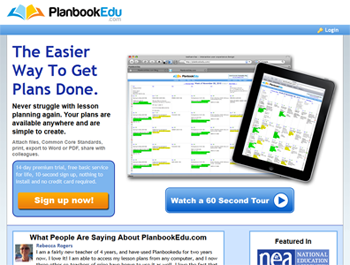
Your
plans are available anywhere and are simple to create. Attach files, Common
Core Standards, print, export to Word or PDF, share with colleagues.
 |
7. Quizinator - e-Learning tool for Teachers, Instructors, and Homeschoolers
Create, Store, and Print worksheets, studysheets, exams and quizzes online.
Designed specifically for teachers, instructors, and homeschoolers.
 |
CarrotSticks is an online multiplayer game that improves math skills for 1st -
5th graders as they
practice and compete with peers around the world.
 |
|
|
Source :
Langganan:
Postingan (Atom)